Showing posts with label box cars. Show all posts

Saturday, February 15, 2014

Money Madness {Part Two} and a {Freebie}

Of all my money skills games, this one is my favorite!  
This game is called "Trading Up".  This post is a continuance from a previous post with other great freebies.  You can check that one out here.


I discovered this awesome resource while cruising a site called Math Wire.  Among their other great teaching aids, this game is essential, in my opinion, for teaching money.  Did I mention it's completely free?!?!?
The original actually looks like this:  (click on the image to get your own copy.)


But I made a few tweaks to it so that the students would get more from it.  Here's my version.  Click on it for a copy.


The first thing I changed was including a nickel slot in the dimes section.  I know it might confuse the kids if there is a nickel sitting in the dimes section, but I really needed my classes to start thinking that a quarter can also be two dimes and a nickel.  Besides, how are they supposed to trade up two dimes for a quarter?


The second thing I tweaked was the addition of a half-dollar section.  Though half-dollars aren't part of the core, I still feel they should be included.  Not only that, but it helps to reinforce that 50 is half of 100.


The spinner came from the resource book from our old math series, but you can easily create your own.  Or you can have your kiddos roll a dice or draw cards out of a bag.  
The amounts are: 1¢, 2¢, 5¢, 6¢, 8¢, 11¢, and 13¢.

Materials needed for play: a Trading Up work mat, a spinner, and a baggie of coins.  (Note: the work mats in these pictures do not include the mentioned "new" half-dollar section. These are the older ones and I plan on replacing them soon.)

Here's how you play.  The student spins the spinner and finds the coins needed to make the amount spun.  Then, they place the coins in the correct spaces on the work mat.  For example, if they spun 11¢, they dig out a dime and a penny and place those on the mat.  The dime fills a "dime" slot and a penny fills a "penny" slot.  You get the idea.  With each spin, they begin to fill up slots.  Once all the slots are filled in any certain section, the student needs to "Trade Up".  
If they have all five penny slots filled, they can trade those for a nickel. Two nickels for a dime, two dimes and a nickel for a quarter, and so on.
The game continues until they have traded up to a dollar.  The first to a dollar wins!


Every so often, I call "Stop Action", which is a signal to immediately stop play and place hands flat on the desk.  I learned this little trick from John and Jane Felling at Boxcars and One-Eyed Jacks.  It is brilliant and works like a charm.  I get instant attention from the whole class.  And we all know how hard that is, especially when the kiddos are playing with manipulatives, don't we?

Anyway...... When I call stop action, I have the students count up the money they've accumulated on their work mats and whisper the amount to their partner.  Then, to assure accountability, I meander around and ask students to whisper it to me.

~Stacy


Tuesday, February 4, 2014

Money Madness! {Freebie!}

Money, money money! It's crunch time ladies!  According to CCSS, 2nd graders are expected to master time and money.  So that means we will be eating, sleeping, and speaking time and money for the next several weeks.  We're still finishing up a chapter on 3-digit addition and subtraction, but since my kids just FLY through those lessons, I thought I'd use the extra time to get money rolling. 

Right now we are only working with dimes, nickels, and pennies.  But all of these activities can be adapted to use quarters.  (Half-dollars are not included in the core but I'm sure they can be integrated somewhere!)  
These activities are great for time-fillers but would also be perfect for math centers.  I have the worksheets in plastic sheet protectors (trying to save a few trees!) but you could just ask easily laminate the pages and dry erase works just as well.

Money Grab Bag
Here the student has a mesh baggie with nine coins: 3 dimes, 3 nickels, and 3 pennies.  She pulls three random coins out of the bag, records each coin from largest to smallest.  Then she counts the coins and writes the total amount on the line.  Easy-peasy!  Later, I can just toss in 3 quarters and the activity goes to a whole new level!

For this activity, you need a worksheet and a set of coins:  3 dimes, 3 nickels, and 3 pennies.

Click on the image to get this freebie.

Nickel Strike-Out
Here the students are working with just nickels.  Most of our coins are divisible by five.  That means we can skip count by fives to count money.  This activity makes the students think of 25 cents as 5 nickels, or 10 cents as 2 nickels.  To play, the student rolls a money die, writes the amount on the line.  Then counts out enough nickels to show that amount and write how many nickels it took.  Since the 1 cent doesn't work so well, I made those the "Strikes".  If they roll a 1 cent, they get a strike, three strikes, you're out!

These money dice were hand-me-downs so I'm not sure where they came from.  The six sides have 1 cent, 5 cent, 10 cent, 25 cent, 50 cent, and $.  If you can't get your hands on a set of dice like this, you can easily make them or have the students draw cards out of a bag.

For this activity, you need the worksheet, several nickels, and one money dice.

Click on the image to get this freebie.


Money Match-Up
Here the group is taking a given money amount and showing it using dimes, nickels and pennies.  The student just draws a money card from the stack, writes it on the line and then uses coins from the mesh bag to show that amount.  Right now, the card only go up to 30 cents.  As we get further into money, I'll toss in the higher card amounts.  


 For this activity, you need the worksheet, a set of coins, and the money cards.  

 The money cards were leftover from an old calendar set.  I couldn't bring myself to toss these.  You can very easily make your own set for this.

Click on the image to get this freebie.

Pay the Bank
Not only does this get the kiddos working with money, it also reinforces place value.  The student rolls a dice and counts that many pennies out onto their ten frame.  With each turn they should fill up the frame.  Once it's full, they trade the ten pennies for a dime.  The first student to earn 5 dimes wins!


For this activity, you will need a ten frame, a dice, several dimes and pennies.

BTW..... the mesh bags that I keep (most) of my small manipulatives in came from Boxcars and One-Eyed Jacks.  They are perfect for small things like coins and dice.  The baggies also make disinfection super-simple.  Just toss your bags (manipulatives and all!) into the wash with a touch of detergent and bleach and the germs wave bye-bye!


The sheet protectors came from C-Line.  You can get a set of 10 for $23.  I know, that sounds high but these babies can sure take a beating!  Click on the picture to take you to the C-Line site.Reusable Dry Erase Pockets, Assorted, 9 x 12, 10/PK, 40810
Enjoy the latest weather, friends!

~Stacy


Wednesday, September 25, 2013

Small Group Work and a FREEBIE!

Wednesday is always a day the kiddos look forward to because it is Small Groups Day.  Every Wednesday, I group the students and give them a full hour to "play games".  At least, that is how they see it.  Actually, they are working on special skills that need a little tweaking.
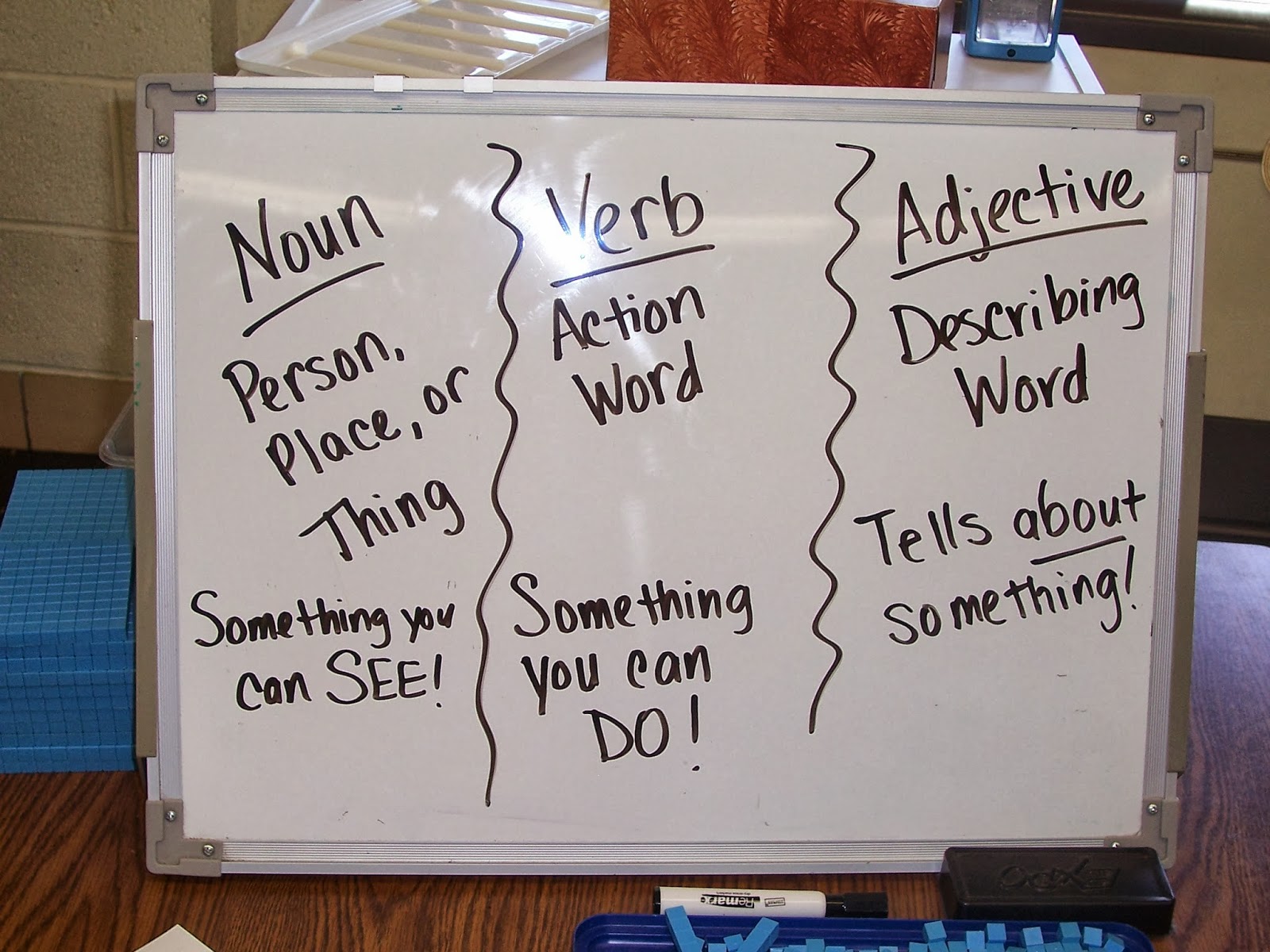
This week, I had the groups work on Parts of Speech (Nouns, Verbs, & Adjectives),
Place Value with Horse Race,
Spelling and Phonics skills with Versatiles,
and Computer Skills with ABC Ya!

One of the skills that I discovered very early on in the year that needed A LOT of work was Parts of Speech.  My sweeties really had a tough time naming nouns, verbs and adjectives within sentences.  So I pulled together this activity.

I pulled out my noun, verb, and adjective word tiles that I got from Wal-Mart a million years ago. 

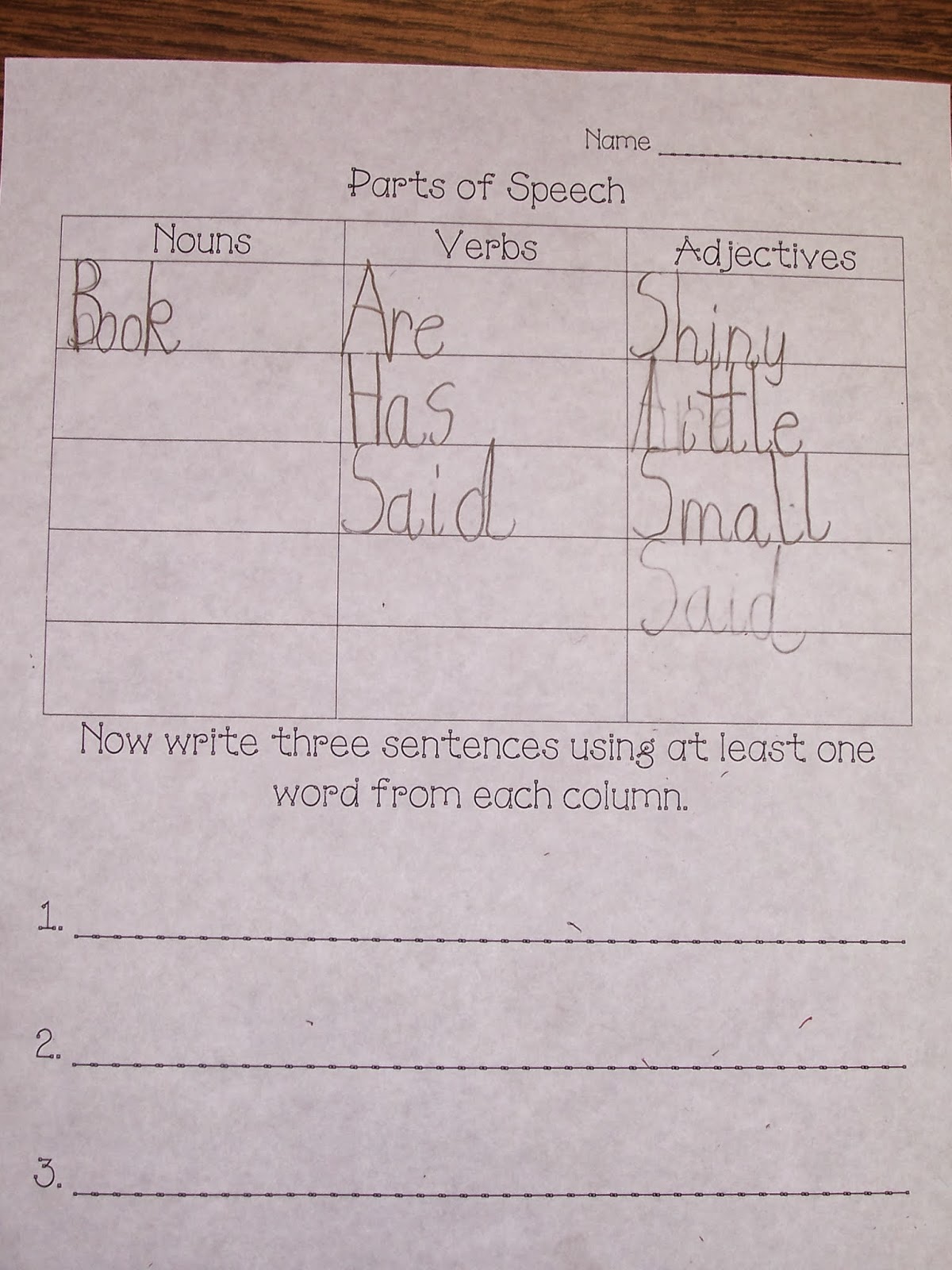
The students were to draw a tile out of the bag and write the word in the correct section on a worksheet. 
Here is a sample of what the first group had going so far.  


Click the worksheet or here for the FREEBIE!

This shows a group working on Place Value using StrataDice from Box Cars and One-Eyed Jacks.  If you would like to learn how to play the game the kids are playing, you can read a post I did on these last year.

This is a quick pic of a student working with VersaTiles.  I discovered VersaTiles (an ETA product) years ago when I was a tutor for Sylvan Learning Center.  These are a great way for your students to work on important skills without killing a bunch of trees.  I will be doing a post soon on this incredible product and it's uses in the classroom.  
Finally, the babes had a chance to get on the computer and play some learning games through ABC Ya!
This week I let them choose which games to do, but soon I will be giving them direction on what to be working with.

Like I said, we have an hour for these activities, so I usually give the groups 20 minutes to work and then we rotate to the next station.


That's all for now!  Be sure to grab that FREEBIE for your own parts of speech activities!

~Stacy


Wednesday, May 22, 2013

Horse Races & Animal Teeth!

It must seem like I'm a walking, talking billboard for Boxcars and One-Eyed Jacks!  Once again, I'm posting about another of their WONDERFUL products.
 
These are their Stratedice.  There is a wealth of games you can play using these babies.  Today I had my class using them to practice place value to hundreds and multiplication. 
 
Horse Race
Here's how you play:  Pair your students and give them one tray.  The kids CAREFULLY empy both trays and divide the dice by color.  This game is played like War.  Each student takes two dice and rolls them.  If you are playing Place Value, they arrange the dice into tens and ones.  The student with the biggest (or smallest if you choose) wins that round.  The winning dice go onto the Race Track (the black tray) and the losing dice go to the Barn (the clear tray).
 
The important thing to remember here, is that the students must learn to verbalize WHY they won. 
For example, the white dice has the number 651.  The blue has 411.  The white dice wins because "6 hundreds are greater than 4 hundreds."
 
 
After a few rounds of playing Place Value Horse Race, I had them work on Multiplication.  Here the kids roll two dice and find the product of the two numbers.  The student with the highest number wins.  Remember, they need to verbalize why they win!
 
Since I'm talking about multiplication, I just HAD to share something that I discovered a couple years ago and have used it to help my students remember their multiplication facts. 
 
It is called Memorize in Minutes: The Times Tables.  It was written by Alan Walker.  It doesn't have a cutsy cover, so I just made one.  What the author has done is come up with short stories to go along with each fact and it creates a memory hook.  Each number is given an image and those images and words are used in the story.  Here's one of my favorites:
 
"One evening there was a party for a queen at a big hotel.  The hotel had revolving doors.  When the queen got to the hotel, she was amazed to see the revolving doors.  She had never seen doors like those before.  She pushed the doors and went around and around because it was so much fun.  Soon she became dizzy and felt sick.  She had become a sick queen."
 
The greatest thing about this is that it's completly FREE!  Get your own copy right here.
 
Animal Teeth!
I was so excited to try this activity that was created by Yolanda Arnold over at Oceans of First Grade Fun
 
 I had recently gotten a copy of "What If You Had Animal Teeth" from my Scholastic book order and then came across Ms. Arnold's post.  I thought this would be a great project to do in our final days of school. (Only 3 more days for us!!!!!!)
 
My kids had so much fun doing this activity and their projects came out AWESOME!
Here is a Vampire Bat and Rattlesnake.

Here is a Beaver and a Crocodile.
This is certainly going to become a regular project in my classroom!
 
~Stacy


Tuesday, May 14, 2013

Making Words & Sammies! {Freebie!!!}


With the school days winding down, the kids are getting antsy.  So when that happens, I pull out the Box Cars activities.  Today's fun is called "Word Shapes".  This game has the students rolling letters and trying to build words.  But they need to be strategic!  The slots are shaped for tall, small, and fall letters and the student must think about words they know and if certain consonants can be found at the beginning or the end.  Middle slots should be saved for vowels . . . but not always.

First the students are divided into pairs and given a 30-sided dice with vowels, consonants and four wilds.  We got ours from BoxCars and One-Eyed Jacks but you could also have the kids pull letters from a bag. 

The students take turns rolling (or pulling) and write a letter in the appropriate box, depending on the shape.  Once a letter is placed, it cannot be moved.  The first student to make 3 words, WINS! 


Here's the FREEBIE!

Click on the image below for your very own set of this game.  Just in case you can't get your hands on the 30-sided dice, I also included a set of letter and word cards.  You may want to make the consonants blue, the vowels red, and the wilds green.  I copied the Word Shapes sheet out on colorful paper and laminated.  The students use a dry-erase marker to complete the activity.


And last week, I finally decided how I wanted to use the Sandwich Coasters I found at Dollar Tree (thanks to Krista at The Creative Chalkboard).  I used Avery labels to give each ingredient a money value.  I kept the amounts easy to calculate, for now.
Bread:  25 cents
Ham:  75 cents
Bacon:  75 cents
Swiss Cheese:  50 cents
Cheddar Cheese:  50 cents
Lettuce: 50 cents
Onion:  25 cents
Tomato: 50 cents 

I partnered the class up and gave them a dry-erase board and a set of ingredients and told them they would be working in a sandwich shop today.  To take the sandwich shop idea even further, you may want to provide aprons and food-prep gloves for the class as they make the sandwich!
The rest is simple.  Give the class an "order".  They need to make the sandwich and calculate how much it will be.  Here are a few shots of what my kids were doing to figure out how much each sandwich would cost.


I just LOVED how this group combined prices to make a $1.00 to make adding everything else up easier.

After the kids get comfortable, you could tell them that the customer only has a certain amount of money to spend.  Their job is to come up with sandwich combinations that total that amount. 

That's all for now!

~Stacy